Furnace inducer motor not starting: safe diagnostic
Quick answer
A furnace inducer motor not starting does not automatically mean the motor has failed. After confirming a genuine thermostat heat call, record whether the furnace is silent, hums without starting, starts and stops, runs without reaching ignition, or has already moved to a later sequence stage. Those patterns separate an earlier input or safety stop from a motor, control, wiring, draft-proving, venting, or condensate branch. Keep the cabinet assembled and have a qualified HVAC technician diagnose the exact model.
Common questions
- Why is my furnace inducer motor not starting?
- The furnace may not have received or accepted a heat call, a safety or control condition may be holding the sequence, or the inducer, its wiring, its model-specific controls, or its power supply may have a fault. Sound and visible movement alone cannot identify which component failed.
- Does a humming inducer mean the motor is bad?
- Humming without normal startup narrows the symptom but does not prove the motor is the root cause. Turn the furnace off, do not spin the wheel or keep retrying it, and have a qualified technician use the exact model literature to evaluate the assembly, any model-specific starting components, supply, wiring, and control.
- Can I spin a furnace inducer wheel by hand to get it started?
- No. Do not remove a panel, defeat the door interlock, reach into the assembly, or spin the wheel. The furnace contains line-voltage, hot, sharp, gas, and combustion components, and forced movement can cause injury or mask the actual fault.
- What if the inducer runs but the furnace does not ignite?
- That is usually a later draft-proving branch rather than an inducer no-start symptom. Record the exact fault code and whether the inducer stays on, then have a technician evaluate the intake, exhaust, condensate, sensing path, pressure-switch circuit, wiring, and control for the exact model.
Source note: Reviewed October 2026 against current Goodman/Amana/Daikin and Lennox gas-furnace service literature, Daikin modulating-furnace inducer documentation, ENERGY STAR maintenance guidance, and 2026 U.S. Consumer Product Safety Commission heating-safety guidance. Ignition order, inducer type and speed control, fault codes, electrical values, draft requirements, approved parts, and service procedures are model-specific; the current manual for the complete installed model controls.
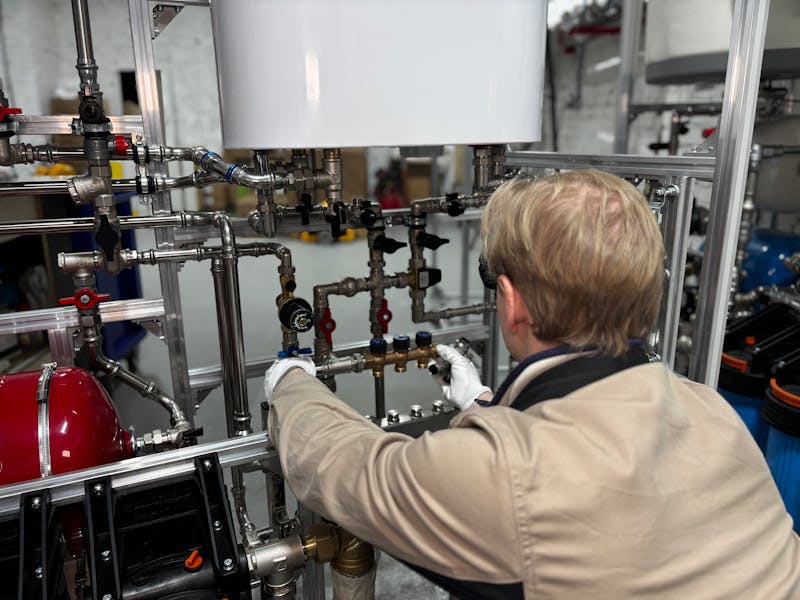
If your furnace inducer motor is not starting, do not order a motor based on silence alone. First confirm that the thermostat is making a genuine heat call, then record the last step the furnace completes with every access panel closed.
The useful distinction is whether the furnace is silent, hums without starting, starts and stops, or runs without reaching ignition. Those observations give a technician more than “the furnace will not turn on.”
Stop after one normal heat-call observation. Do not defeat the cabinet interlock, probe energized components, jumper a pressure switch, spin the inducer wheel, alter a vent or gas component, or rely on universal voltage, resistance, pressure, or timing thresholds.
What the inducer should do in the furnace sequence
The draft inducer is the smaller combustion-air blower that normally starts before ignition. It is not the larger circulating blower that moves heated air through the ducts.
Lennox’s ML180UH installation instructions place inducer start, pressure proof, and pre-purge before the ignitor. Goodman/Amana/Daikin service literature for covered 80% furnaces follows the same broad order and gives technicians separate command and motor branches.
That broad sequence is useful; the exact details are not universal. A modulating furnace may use a variable-speed inducer, pressure-switch calibration, RPM feedback, and control logic that differ from a single-stage furnace. The complete model number and its current manual must control the diagnosis.
Furnace inducer motor not starting: observation map
Use one ordinary heat call with the cabinet fully assembled. Watch only through a factory viewing port, if the furnace has one, and do not open a panel to gain a better view.
| What you observe | Where the sequence may have stopped | Safe next action |
|---|---|---|
| No heat call appears at the thermostat | Thermostat settings, schedule, zoning, power, or control input may be involved | Confirm the setpoint and mode; record any thermostat alert |
| Heat is requested, but the furnace stays silent | An input, power, safety, control, wiring, or inducer branch may be involved | Record the exact display or status code and arrange service |
| A larger blower starts immediately, but the inducer does not | A limit, rollout, control, or other model-specific safety response may be active | Shut the furnace off and preserve the code; do not reset a rollout switch |
| The inducer hums but does not start normally | The motor or assembly, supply, wiring, control, or a model-specific starting component may be involved | Turn the furnace off; do not spin, tap, or keep retrying it |
| The inducer starts and then stops or retries | The control may be responding to a lost command, an unexpected safety state, draft proof, motor feedback, wiring, or a control fault | Note the run time, code, and number of attempts; stop repeated resets |
| The inducer runs steadily, but ignition never begins | Intake, exhaust, condensate, sensing path, pressure-switch circuit, draft, wiring, or control may be involved | Follow the pressure-switch diagnostic without touching tubing or venting |
| The ignitor glows or sparks | The furnace has moved beyond an inducer no-start symptom | Use the ignitor sequence guide for the correct later branch |
| Burners light and then go out | The furnace reached flame proof | Use the flame-sensor symptom guide instead of blaming the inducer |
| Heat starts, then ends later in the cycle | The original startup sequence completed | Classify the timing with the short-cycling diagnostic |
This map locates the symptom; it does not diagnose a part. “Inducer not getting power” requires a qualified technician to establish whether that model should be commanding it at that moment.
If there is no movement or sound
Confirm heat mode, a setpoint above room temperature, and an active heat call. Photograph a code through the factory viewing port, if provided. Silence may reflect the thermostat input, a safety state, control logic, wiring, power, motor protection, or the inducer itself. If a panel is loose or missing, leave the furnace off; never hold or defeat its door switch.
If the inducer hums but will not start
A hum may direct a technician toward the inducer assembly, supply or wiring, the control, or a model-specific starting component. Turn the furnace off. Do not spin the wheel, strike the housing, add lubricant, substitute a capacitor, or keep retrying it.
If the inducer starts and stops
Record the run time, sound change, next stopping point, retries, code, weather, and recent work. Possible branches include command loss, a safety response, draft proof, condensate, motor feedback, wiring, supply, motor, or control. Daikin’s modulating-furnace service manual illustrates the model-specific difference: its covered control varies inducer speed and learns pressure-switch operating points. If heat is produced before shutdown, use the furnace short-cycling guide.
If the inducer runs but pressure is not proved
An inducer that runs while ignition never begins may be waiting for draft proof. From safe ground level, note visible snow, ice, leaves, or damage at an exterior termination, plus water, drain overflow, gurgling, recent work, and weather dependence. Do not climb, detach tubing, clear ports, open a trap, or modify venting. Use the pressure-switch guide to prepare evidence without condemning the switch or inducer.
When to stop troubleshooting immediately
- Gas odor or hissing: Leave immediately without operating switches, phones, thermostats, or appliances inside. Call the gas utility or emergency services from outside.
- Carbon-monoxide alarm or possible CO symptoms: Get everyone into fresh air, call 911, and do not reenter until responders say it is safe. Follow the carbon-monoxide and HVAC safety guide.
- Flame outside the normal enclosed burner area, smoke, soot, scorching, or fire: Leave the building and call emergency services. Do not restart the furnace.
- A rollout code or visibly tripped safety: Keep the furnace off and arrange qualified inspection. Never reset or bypass the safety to obtain heat.
The U.S. Consumer Product Safety Commission’s 2026 heating-safety guidance warns that blocked, defective, poorly maintained, or incorrectly installed fuel-burning systems can create fire and carbon-monoxide hazards.
What to send the HVAC technician
Prepare a concise handoff before the appointment:
- Complete brand, model, and serial number from paperwork or an owner-accessible label
- Exact thermostat message and board code, with a photo or video
- Ordered sequence from heat call through shutdown and retries
- Whether the inducer is silent, humming, stopping, or running continuously
- Weather, visible exterior termination conditions, water, gurgling, noise, or odor
- Recent work and any gas, CO, smoke, soot, flame, or health warning
Put the evidence in the HVAC maintenance log. Avoid cycling power before the visit unless emergency guidance requires shutdown; a reset can clear useful fault history.
What a qualified diagnosis should establish
A useful service report should identify the exact model literature and last completed sequence step, then show evidence separating command, safety, supply, wiring, motor, draft, condensate, and control branches. After correction, it should document a complete heat cycle and every model-required safety, gas, venting, combustion, temperature-rise, and airflow check. ENERGY STAR’s maintenance checklist likewise places electrical, starting-cycle, gas, combustion, and heat-exchanger checks with the contractor.
Sources and further reading
- Goodman/Amana/Daikin: service and troubleshooting manual for covered 80% furnaces
- Lennox: ML180UH installation instructions and sequence of operation
- Daikin: modulating-furnace service manual and inducer calibration
- U.S. CPSC: 2026 furnace and carbon-monoxide safety guidance
- ENERGY STAR: heating and cooling maintenance checklist
- Image: МОБО Модульные Котельные on Pexels
Your next step
Record one closed-cabinet heat call and send the exact model, code, and sequence to a qualified HVAC technician. Ask the technician to identify the last completed step and document model-specific evidence before authorizing an inducer motor, pressure switch, control, or wiring repair.
The pattern matters more than the guessed part: silent, humming, starts and stops, or runs without proving are four different service branches.
Continue the furnace ignition diagnostic safely
Use these resources to follow the draft-proof and later ignition branches, protect occupants, and preserve evidence for model-specific service.
- Furnace pressure-switch code
Follow the draft-proof branch when the inducer runs but ignition does not begin.
- Furnace ignitor not glowing
Move to the ignition-source branch after inducer operation and draft proof.
- Carbon monoxide and HVAC safety
Review alarm, symptom, evacuation, and emergency-response boundaries.
- HVAC maintenance log
Record the model, fault code, ordered sequence, weather, recent work, and service findings.

ThermalTechPro Team
Independent trade-focused editorial team